Behavioral activation
Why action comes before motivation when mood is low, and how to use that.
2 min read
Reviewed by Shariq Refai, MD, MBA, FAPA. Verify: ORCID, Wikidata, NPI Registry, all links.
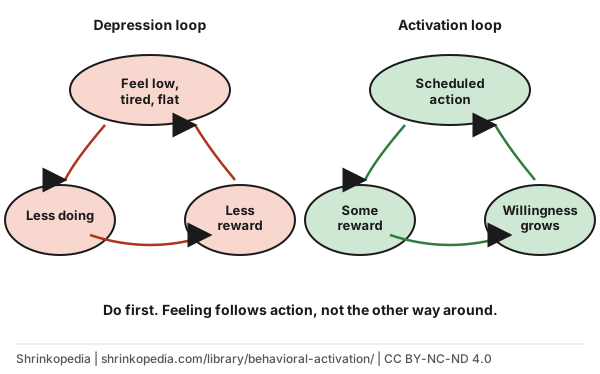
Low mood shrinks activity. Less activity means fewer sources of pleasure and accomplishment, which lowers mood further. Behavioral activation attacks that loop directly, using small planned actions to restart the system, because in depression, motivation follows action instead of leading it.
How it works
The loop
Feel low, do less, feel worse, do even less. The loop is self reinforcing and it does not care about your intentions, only your behavior.
Action before motivation
Waiting to feel like it is the trap. In low mood the feeling arrives after you start, not before. Starting is the treatment.
Values point the way
Pick actions connected to what matters to you, not just chores. Contact with a friend, ten minutes outside, one small piece of something you used to care about.
Schedule it, do not decide it
Put the action at a specific time on a specific day. A scheduled plan removes the in the moment negotiation your low mood will always win.
Start embarrassingly small
Not the gym, a walk to the corner. Not cleaning the house, clearing one surface. Small enough that you cannot argue with it.
Rate mood before and after
Score your mood from 0 to 10 before and after each activity. The record beats the memory, because depression edits memories toward nothing helps.
Watch for avoidance in disguise
Scrolling, napping, and staying busy with low value tasks all feel like coping. Track what each one actually does to your mood an hour later.
How to use this page
- Plan tomorrow tonight: two small actions, tied to times, one of them involving another person or the outdoors.
- Judge the experiment by the numbers you wrote down, not by how you feel about it afterward.
- Consistency beats size. Seven tiny actions in a week outperform one heroic Saturday.
Worth knowing
In head to head trials, behavioral activation has performed comparably to full cognitive therapy for depression, which is remarkable for something this simple. Simple does not mean easy. The hard part is doing it when everything in you says it will not help.
Rooted in the behavioral research of Peter Lewinsohn and developed as a standalone treatment by Neil Jacobson and colleagues. A well supported treatment for depression.
How to cite this page
- Short
Behavioral activation. Shrinkopedia, medically reviewed by Shariq Refai, MD, MBA. https://shrinkopedia.com/library/behavioral-activation/- APA
Shrinkopedia. (n.d.). Behavioral activation. Medically reviewed by Shariq Refai, MD, MBA. https://shrinkopedia.com/library/behavioral-activation/- MLA
"Behavioral activation." Shrinkopedia, https://shrinkopedia.com/library/behavioral-activation/.
Click a citation to select it.