Cognitive distortions
Ten common thinking patterns that make situations feel worse than the evidence supports.
2 min read
Reviewed by Shariq Refai, MD, MBA, FAPA. Verify: ORCID, Wikidata, NPI Registry, all links.
Cognitive distortions are habitual thinking shortcuts that bend reality in a negative direction. Everyone uses them sometimes. They matter because the brain treats the distorted thought as fact, and mood follows the thought. Naming the pattern is the first step in loosening its grip.
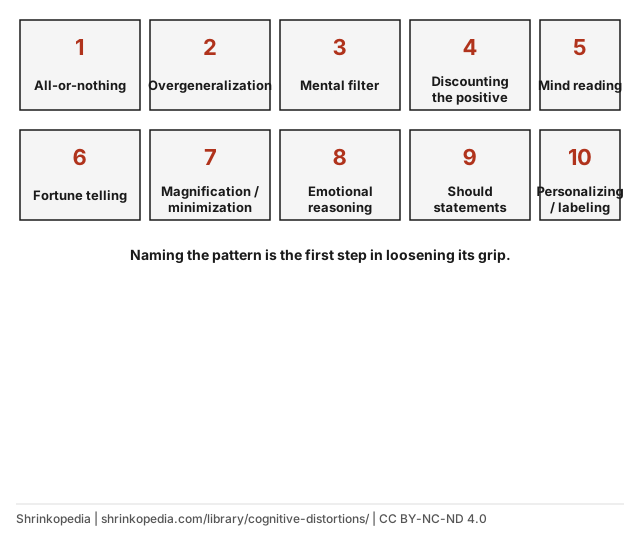
The ten common distortions
All or nothing thinking
Seeing things in only two categories. "If I'm not perfect, I failed." Real life mostly happens in the middle.
Overgeneralization
Turning one event into a permanent rule. "I got rejected once, so I always get rejected."
Mental filter
Zooming in on the one negative detail and screening out everything that went well.
Discounting the positive
Explaining away good things. "They only said that to be nice." Wins stop counting as evidence.
Mind reading
Assuming you know what someone else is thinking, usually something bad about you, without checking.
Fortune telling
Predicting a bad outcome and reacting as if the prediction were already true.
Magnification and minimization
Blowing up mistakes and shrinking strengths, like looking at yourself through the wrong end of binoculars.
Emotional reasoning
Treating a feeling as proof. "I feel like a burden, so I must be one." Feelings are data, not verdicts.
Should statements
Rigid rules about how you or others must behave. They mostly generate guilt pointed inward and resentment pointed outward.
Personalization and labeling
Taking blame for things outside your control, or collapsing a whole person into one word like "loser" after a single event.
How to use this page
- When a thought spikes your mood, write it down and check it against this list.
- Name the pattern, then ask what a fair witness would say about the same situation.
- You are not trying to think positively. You are trying to think accurately.
Worth knowing
Distortions show up more when you are tired, stressed, hungry, or low. That is not a character flaw. It is how brains conserve effort under load, which is exactly when accurate thinking matters most.
Catching a distortion does not instantly change the feeling. With practice, the gap between the thought and your belief in it widens, and that gap is where mood starts to shift.
Based on the cognitive model developed by Aaron T. Beck and popularized by David Burns. Widely used in cognitive behavioral therapy.
How to cite this page
- Short
Cognitive distortions. Shrinkopedia, medically reviewed by Shariq Refai, MD, MBA. https://shrinkopedia.com/library/cognitive-distortions/- APA
Shrinkopedia. (n.d.). Cognitive distortions. Medically reviewed by Shariq Refai, MD, MBA. https://shrinkopedia.com/library/cognitive-distortions/- MLA
"Cognitive distortions." Shrinkopedia, https://shrinkopedia.com/library/cognitive-distortions/.
Click a citation to select it.