Cognitive load
Why your brain feels full, and how to spend its limited bandwidth on purpose.
2 min read
Reviewed by Shariq Refai, MD, MBA, FAPA. Verify: ORCID, Wikidata, NPI Registry, all links.
Working memory, the part of the mind that holds and works with information right now, has a hard capacity limit. Cognitive load is how much of that capacity a task consumes. When demand exceeds capacity, performance does not degrade gracefully. It drops off a cliff, and it feels like being stupid. It is not.
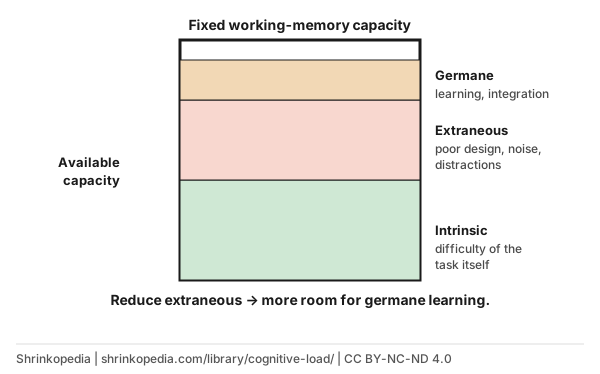
The three loads and the fixes
Intrinsic load
The difficulty built into the material itself. Learning calculus carries more than learning a phone number. You manage it by sequencing and chunking, not by wishing it smaller.
Extraneous load
Effort wasted on everything that is not the task: cluttered interfaces, unclear instructions, notifications, background noise. This is the load you can actually delete.
Germane load
The productive effort of connecting new information to what you already know. This is the load you want. Good learning design protects room for it.
Signs of overload
Rereading the same paragraph, forgetting step one while doing step three, irritability out of nowhere, and the strong urge to quit tasks you are capable of.
Fix: write it down
Every item held in working memory is bandwidth spent. Lists, notes, and calendars are external memory. Offloading is the single cheapest upgrade available.
Fix: one thing at a time
Multitasking is rapid switching, and every switch pays a reload cost. Single tasking is not a virtue, it is arithmetic.
Fix: shrink the step
If a task feels impossible, the current step is too big for the available bandwidth. Cut it until it fits. Momentum does the rest.
Fix: clear the channel
Close tabs, silence the phone, clean the surface you work on. Every stray input is rented working memory you are paying for.
How to use this page
- When you feel dumb, diagnose load first: what is eating bandwidth that is not the task itself?
- Before hard work, spend two minutes deleting extraneous load. It pays back immediately.
- Stress, poor sleep, and pain all shrink capacity. On depleted days, plan smaller steps on purpose.
Worth knowing
Cognitive load theory was built for instructional design, but its reach is wider: it explains why bureaucratic friction is exhausting, why good checklists save lives, and why the same person can look brilliant in a quiet room and scattered in a loud one.
Based on cognitive load theory, developed by John Sweller, and working memory capacity research in cognitive psychology.
See also on ShrinkDaily
- ShrinkDaily's daily concept on cognitive load
For a three-minute daily read on the same idea, see ShrinkDaily's daily concept on cognitive load.
How to cite this page
- Short
Cognitive load. Shrinkopedia, medically reviewed by Shariq Refai, MD, MBA. https://shrinkopedia.com/library/cognitive-load/- APA
Shrinkopedia. (n.d.). Cognitive load. Medically reviewed by Shariq Refai, MD, MBA. https://shrinkopedia.com/library/cognitive-load/- MLA
"Cognitive load." Shrinkopedia, https://shrinkopedia.com/library/cognitive-load/.
Click a citation to select it.