Maslow's hierarchy of needs
The five levels of human need, and what the famous pyramid gets right and wrong.
2 min read
Reviewed by Shariq Refai, MD, MBA, FAPA. Verify: ORCID, Wikidata, NPI Registry, all links.
Abraham Maslow proposed that human motivation is organized around a set of needs, from bodily survival to becoming fully yourself. The pyramid version everyone knows is a later simplification, but the core insight holds: unmet basic needs shout, and they make the higher ones hard to hear.
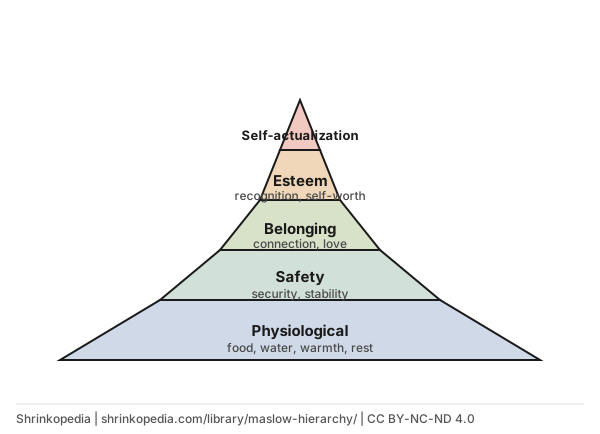
The five levels
1. Physiological needs
Food, water, sleep, warmth, health. When these are unmet they dominate everything. Nobody contemplates purpose while starving, and sleep deprivation alone can imitate half of psychiatry.
2. Safety needs
Physical security, stable housing, income, health, and predictability. Chronic financial or physical insecurity keeps the threat system running in the background of every thought.
3. Love and belonging
Connection, intimacy, friendship, being part of something. Loneliness is not a soft problem. Its health effects rival established medical risk factors.
4. Esteem
Respect from others and respect for yourself: competence, recognition, dignity. When it is missing, people either shrink or spend their lives performing.
5. Self actualization
Becoming what you are capable of becoming: creativity, purpose, growth for its own sake. Maslow thought few people spend much time here, not because it is exotic, but because the lower floors keep calling.
What the pyramid gets wrong
Maslow never drew a pyramid and never claimed a strict sequence. People create art while hungry and find belonging in crisis. Needs overlap and trade off. The levels are gravity, not gates.
How to use this page
- When motivation collapses, audit from the bottom up: sleep, safety, money, connection, respect, then meaning.
- Supporting someone? Meet the level they are actually on. Purpose talk lands badly on an empty stomach.
- Use it as a map of attention, not a report card. Nobody finishes the pyramid.
Worth knowing
The hierarchy is often dismissed as unscientific, and as a strict staircase it is. But large cross national surveys have found that the needs Maslow named do track human wellbeing across cultures, even if the ordering is looser than the pyramid suggests. It endures because it names something true: context shapes what people can care about.
Based on Abraham Maslow's theory of human motivation, first proposed in 1943. The pyramid diagram was a later popularization by others.
See also on ShrinkDaily
- ShrinkDaily's daily concept on maslow hierarchy
For a three-minute daily read on the same idea, see ShrinkDaily's daily concept on maslow hierarchy.
How to cite this page
- Short
Maslow's hierarchy of needs. Shrinkopedia, medically reviewed by Shariq Refai, MD, MBA. https://shrinkopedia.com/library/maslow-hierarchy/- APA
Shrinkopedia. (n.d.). Maslow's hierarchy of needs. Medically reviewed by Shariq Refai, MD, MBA. https://shrinkopedia.com/library/maslow-hierarchy/- MLA
"Maslow's hierarchy of needs." Shrinkopedia, https://shrinkopedia.com/library/maslow-hierarchy/.
Click a citation to select it.