Reward prediction error
The brain signal behind motivation, habits, and why surprises feel so good.
2 min read
Reviewed by Shariq Refai, MD, MBA, FAPA. Verify: ORCID, Wikidata, NPI Registry, all links.
Your brain is a prediction machine. Dopamine neurons constantly compare what you expected with what you got, and the difference is the reward prediction error. That error signal, not pleasure itself, is what teaches the brain what to want and what to chase next.
How the signal works
Better than expected
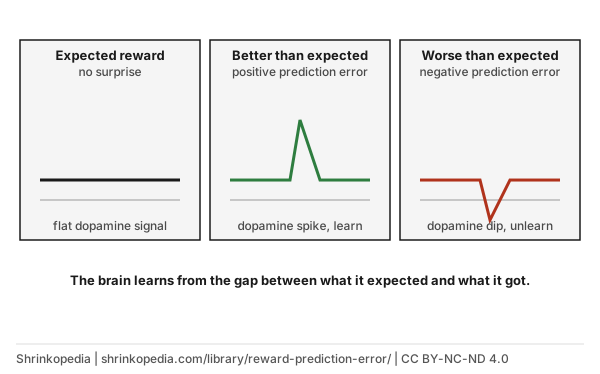
Outcome beats prediction and dopamine spikes. The unexpected compliment, the surprise win. The brain marks whatever preceded it as worth repeating.
Exactly as expected
Prediction met, little signal. This is why the raise feels amazing for two weeks and then becomes the baseline. The brain saves its teaching signal for news.
Worse than expected
Outcome falls short and dopamine dips below baseline. Disappointment is a learning signal too, marking whatever preceded it as less worth pursuing.
Dopamine is not pleasure
It is closer to wanting than liking. It fires most before and during pursuit, not during enjoyment. This is why you can crave things you no longer even enjoy.
The signal moves to the cue
With repetition, the spike shifts from the reward to whatever predicts it: the notification sound, the fridge door, the app icon. At that point the cue itself drives behavior. That is a habit.
Why unpredictability hooks
Variable rewards keep prediction error alive because the brain can never settle the forecast. Slot machines, social media feeds, and refreshing your inbox all run on this schedule.
Using it on purpose
Make good habits produce quick, noticeable wins and track them so progress is visible. Make unhelpful loops predictable and boring, and put their cues out of sight. You are not fighting yourself, you are editing forecasts.
How to use this page
- When an app feels impossible to put down, identify its variable reward. Seeing the mechanism shrinks it.
- Building a habit? Attach an immediate small reward. The brain learns from now, not from someday.
- Chasing something you no longer enjoy is a wanting versus liking gap. It is worth pausing on.
Worth knowing
Reward prediction error is one of the few ideas in neuroscience with a precise mathematical form that also survives contact with everyday life. It explains the fading thrill of the new phone, the pull of the refresh button, and why celebrating small wins is not a motivational poster but a mechanism.
Based on the dopamine neuron research of Wolfram Schultz and colleagues, foundational work in the neuroscience of reward and learning.
See also on ShrinkDaily
- ShrinkDaily's daily concept on reward prediction error
For a three-minute daily read on the same idea, see ShrinkDaily's daily concept on reward prediction error.
How to cite this page
- Short
Reward prediction error. Shrinkopedia, medically reviewed by Shariq Refai, MD, MBA. https://shrinkopedia.com/library/reward-prediction-error/- APA
Shrinkopedia. (n.d.). Reward prediction error. Medically reviewed by Shariq Refai, MD, MBA. https://shrinkopedia.com/library/reward-prediction-error/- MLA
"Reward prediction error." Shrinkopedia, https://shrinkopedia.com/library/reward-prediction-error/.
Click a citation to select it.