Rumination
The mental loop that feels like problem solving and works like quicksand.
2 min read
Reviewed by Shariq Refai, MD, MBA, FAPA. Verify: ORCID, Wikidata, NPI Registry, all links.
Rumination is repetitive thinking about past events, mistakes, and their meaning, running the same footage looking for a different ending. It feels productive from the inside. It is one of the strongest known thinking patterns linked to depression, and it responds well to specific counter moves.
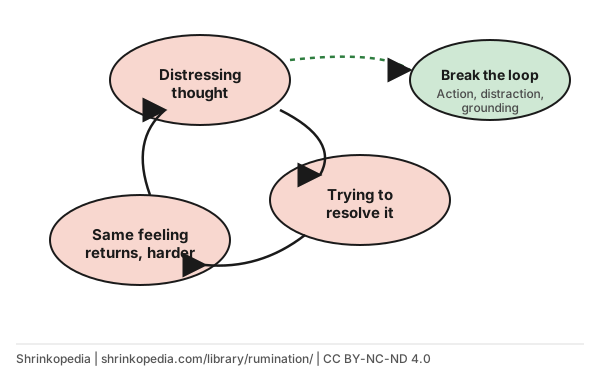
The loop and how to break it
What it looks like
Replaying conversations, re-litigating decisions, asking why did this happen and what is wrong with me on repeat. Abstract, past focused, and circular.
Rumination is not problem solving
Problem solving asks what can I do next and ends in an action. Rumination asks why am I like this and ends where it started. The test: after 20 minutes, do you have a next step?
Rumination is not worry
Worry runs forward, rehearsing future catastrophes. Rumination runs backward, autopsying the past. Same engine, different direction, and many people run both.
Why the brain does it
The mind treats unresolved pain like an unsolved puzzle and keeps reopening the file. It is trying to protect you from a repeat. The strategy is understandable and the returns are negative.
Break: catch and name it
Notice the loop and label it. "I am ruminating" is a different mental act than ruminating, and it creates the gap where choice lives.
Break: get concrete
Swap why questions for how questions. Not why did I fail, but what is one thing I would do differently next time. Concrete thinking is the researched antidote to abstract looping.
Break: change the channel with your body
Rumination is strongest when idle. A walk, a shower, a call, a task with your hands. You are not distracting yourself from the problem, you are removing the idle engine it runs on.
Break: give it an appointment
Schedule 15 minutes of deliberate thinking time with paper. When the loop starts outside that window, defer it. Most loops do not survive being postponed.
How to use this page
- Run the 20 minute test on your repetitive thinking: no next step means it is rumination, not analysis.
- Identify your loop triggers, usually idle and tired moments, and pre load those times with something engaging.
- If loops dominate most days or come with persistent low mood, that is a reason to talk to a clinician.
Worth knowing
Nolen-Hoeksema's research found that people who respond to low mood by ruminating stay low longer and are more likely to develop depression than people who respond with action or distraction. The loop is not just a symptom of low mood. It is one of the engines.
Based on the rumination research of Susan Nolen-Hoeksema, whose response styles work connected rumination to the onset and persistence of depression.
How to cite this page
- Short
Rumination. Shrinkopedia, medically reviewed by Shariq Refai, MD, MBA. https://shrinkopedia.com/library/rumination/- APA
Shrinkopedia. (n.d.). Rumination. Medically reviewed by Shariq Refai, MD, MBA. https://shrinkopedia.com/library/rumination/- MLA
"Rumination." Shrinkopedia, https://shrinkopedia.com/library/rumination/.
Click a citation to select it.