Stages of change
The six stage cycle people actually move through when changing a behavior.
1 min read
Reviewed by Shariq Refai, MD, MBA, FAPA. Verify: ORCID, Wikidata, NPI Registry, all links.
Real change is not a decision followed by willpower. It is a cycle with recognizable stages, and people loop through it, often several times, before a change sticks. Knowing which stage you are in tells you what kind of effort actually helps right now.
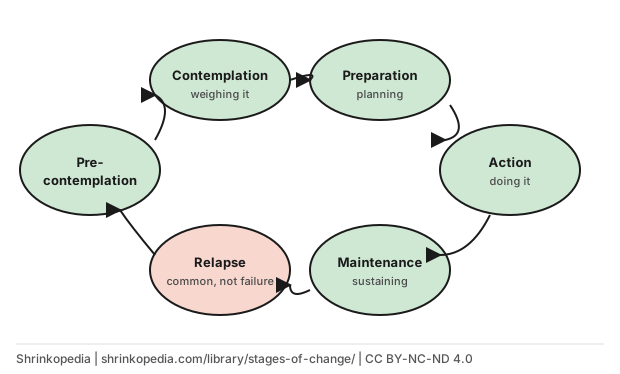
The six stages
1. Precontemplation
Not considering change, often because the costs are not visible yet or past attempts went badly. Pressure here usually produces defensiveness, not movement.
2. Contemplation
Aware of the problem, weighing both sides, not ready to act. People can live here a long time. The useful work is honestly mapping the pros and cons.
3. Preparation
Intending to act soon and taking small first steps. Picking a date, telling someone, gathering tools. Planning here doubles the odds the action stage holds.
4. Action
The visible stage where behavior actually changes. It demands the most energy and gets all the credit, but it is only one stage out of six.
5. Maintenance
The long quiet stage of protecting the change and building it into ordinary life. The main work is spotting high risk situations before they arrive.
6. Relapse and recycling
Most people return to old behavior at least once. In this model that is data, not failure. Each pass through the cycle carries lessons the last one did not have.
How to use this page
- Locate your stage first. Action advice is useless in contemplation, and patience is the wrong tool in preparation.
- Match support to stage: information early, planning in the middle, structure and accountability later.
- If you slipped, you are not back at the start. You are one loop further around a spiral.
Worth knowing
The model was built from studying how people quit smoking, many of them without formal treatment. Its central finding holds across behaviors: the people who succeed are usually the ones who kept re-entering the cycle, not the ones who got it right the first time.
The transtheoretical model of behavior change, developed by James Prochaska and Carlo DiClemente.
See also on ShrinkDaily
- ShrinkDaily's daily concept on stages of change
For a three-minute daily read on the same idea, see ShrinkDaily's daily concept on stages of change.
How to cite this page
- Short
Stages of change. Shrinkopedia, medically reviewed by Shariq Refai, MD, MBA. https://shrinkopedia.com/library/stages-of-change/- APA
Shrinkopedia. (n.d.). Stages of change. Medically reviewed by Shariq Refai, MD, MBA. https://shrinkopedia.com/library/stages-of-change/- MLA
"Stages of change." Shrinkopedia, https://shrinkopedia.com/library/stages-of-change/.
Click a citation to select it.