The stress response
What actually happens in your body when the alarm system fires.
2 min read
Reviewed by Shariq Refai, MD, MBA, FAPA. Verify: ORCID, Wikidata, NPI Registry, all links.
The stress response is an ancient survival program. A perceived threat trips the amygdala, which triggers a cascade of adrenaline and cortisol that prepares the body to act before the thinking brain has finished processing what happened. The system is fast, powerful, and not very accurate.
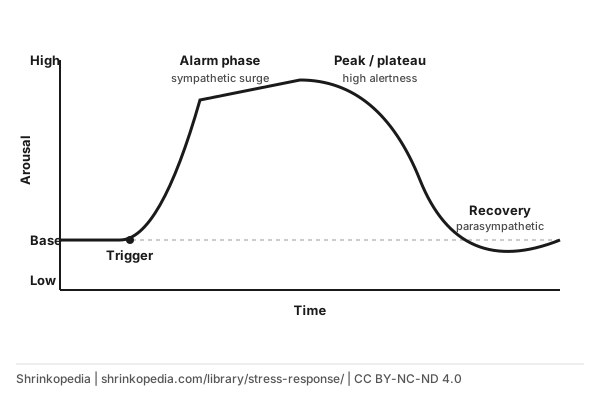
How the alarm works
The trigger
The amygdala flags a possible threat and fires before conscious thought. That is why your heart jumps at a loud noise before you know what it was.
The surge
Adrenaline raises heart rate, blood pressure, and breathing. Cortisol frees up fuel. Blood shifts to the large muscles. Digestion and long term projects go on hold.
Fight
The system pushes toward confrontation. In daily life this looks like irritability, snapping, a short fuse, and arguments that escalate fast.
Flight
The system pushes toward escape. Restlessness, avoidance, canceling plans, the urge to leave the room or quit the situation entirely.
Freeze
The system hits pause. Going blank in the meeting, unable to speak or decide, deer in headlights. It is a protective state, not a choice.
Fawn
The system tries to defuse the threat by appeasing it. Over apologizing, people pleasing, agreeing to things you do not want. Common after relational trauma.
False alarms
The alarm cannot tell a tiger from an email. Modern stressors trip the same circuitry, so the body fires survival chemistry at problems it cannot punch or outrun.
The reset
The response is designed to end. Long exhales, movement, and safety cues tell the body the threat has passed. Chronic activation without reset is what wears the system down.
How to use this page
- When your body reacts strongly, name which response fired. Naming recruits the thinking brain.
- Discharge the chemistry the way it was designed to be used: move your body, then rest.
- A false alarm still feels completely real. Feeling danger is not proof of danger.
Worth knowing
None of the four responses is better or worse. Each one saved lives in the environment it evolved for. Problems start when one response becomes the default answer to everything, including situations where it costs you.
Built on the fight or flight research of Walter Cannon and the stress physiology work of Hans Selye, with freeze and fawn described in later trauma research.
See also on ShrinkDaily
- ShrinkDaily's daily concept on stress response
For a three-minute daily read on the same idea, see ShrinkDaily's daily concept on stress response.
How to cite this page
- Short
The stress response. Shrinkopedia, medically reviewed by Shariq Refai, MD, MBA. https://shrinkopedia.com/library/stress-response/- APA
Shrinkopedia. (n.d.). The stress response. Medically reviewed by Shariq Refai, MD, MBA. https://shrinkopedia.com/library/stress-response/- MLA
"The stress response." Shrinkopedia, https://shrinkopedia.com/library/stress-response/.
Click a citation to select it.