Working memory
The tiny mental workspace everything you think passes through.
2 min read
Reviewed by Shariq Refai, MD, MBA, FAPA. Verify: ORCID, Wikidata, NPI Registry, all links.
Working memory is the mind's active workspace: the place where you hold a phone number while dialing, the start of this sentence while reading its end, and the carry digit while doing math in your head. It is astonishingly small, and most everyday mental struggles run through it.
How it works
The workspace
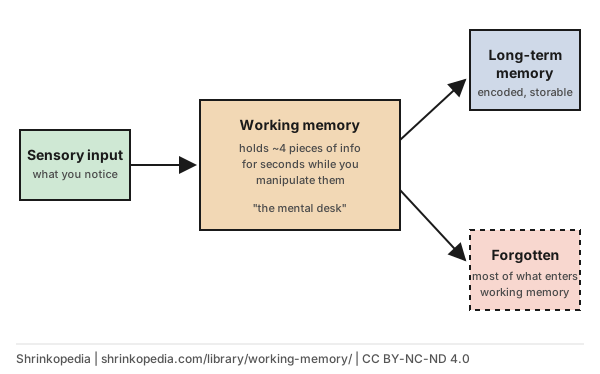
Working memory holds information and works on it at the same time. It is not a warehouse like long term memory. It is a desk, and a small one.
It is smaller than you think
Classic research suggested about seven items. Modern estimates put it near four chunks for most people. That is the desk everyone runs their life on.
Chunking is the workaround
A chunk is whatever your knowledge can bind into one unit. FBICIAUSA is nine letters or three chunks. Expertise is largely the art of bigger chunks.
Sound, image, and control
Research describes separate channels for verbal information and visual information, coordinated by an attention controller. That is why directions survive better as a map plus a phrase than as six spoken turns.
It fades in seconds
Unrehearsed contents evaporate in roughly 15 to 30 seconds. Walking to the kitchen is often longer than that, which explains the doorway amnesia everyone has.
What strains it
Stress, anxiety, sleep loss, pain, and background noise all shrink effective capacity. Anxiety is especially expensive because worrying is itself a working memory task.
Working with it, not against it
Write things down immediately, ask people to repeat and summarize, use one instruction at a time with kids and teams, and stop mid task at a natural boundary, not mid thought.
How to use this page
- Treat forgetting mid task as a capacity event, not a character event. Then offload more.
- When learning something hard, close the loop fast: use it, say it, or write it within 30 seconds.
- Design for four chunks: four point agendas, four line summaries, four step instructions.
Worth knowing
Working memory measured in childhood predicts academic outcomes better than IQ in several studies, largely because every classroom task runs through it. The practical upshot for any age: reduce what must be held in mind, and ability that was always there becomes visible.
Based on the working memory model of Alan Baddeley and Graham Hitch, George Miller's classic capacity paper, and Nelson Cowan's modern capacity estimates.
See also on ShrinkDaily
- ShrinkDaily's daily concept on working memory
For a three-minute daily read on the same idea, see ShrinkDaily's daily concept on working memory.
How to cite this page
- Short
Working memory. Shrinkopedia, medically reviewed by Shariq Refai, MD, MBA. https://shrinkopedia.com/library/working-memory/- APA
Shrinkopedia. (n.d.). Working memory. Medically reviewed by Shariq Refai, MD, MBA. https://shrinkopedia.com/library/working-memory/- MLA
"Working memory." Shrinkopedia, https://shrinkopedia.com/library/working-memory/.
Click a citation to select it.