Metacognition
Thinking about thinking, and why it changes what your thinking can do.
2 min read
Reviewed by Shariq Refai, MD, MBA, FAPA. Verify: ORCID, Wikidata, NPI Registry, all links.
Metacognition is the capacity to notice your own thinking while it is happening. Ordinary cognition solves the problem. Metacognition asks whether you are solving the right problem, whether your approach is working, and whether the story running in your head is actually true. Almost every skill that improves mental health depends on it.
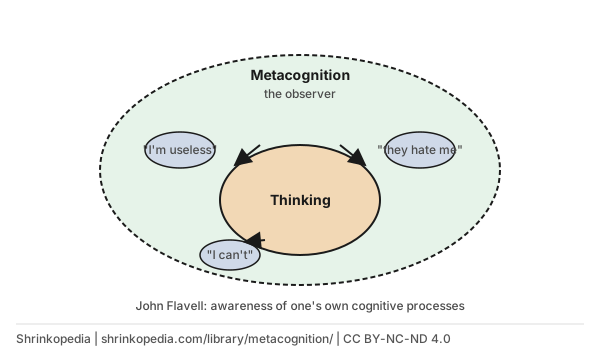
What metacognition looks like
Noticing the thought
A thought lands and you register it as a thought rather than fact. "I am thinking that they are angry with me," not "they are angry with me."
Judging the thought
Once you can see it, you can ask whether it is accurate, whether it is useful, and what a fair witness would say about the same information.
Choosing the next move
Instead of being driven by the thought, you decide what to do with it. Test it, set it aside, ask a real question, or gather better information.
Watching your process
Metacognition also means noticing how you are working. Am I skimming when I should be reading? Am I avoiding when I need to start? Am I explaining or just reacting?
Adjusting in real time
The point is not to catch yourself later. It is to correct course while it still matters. A small course change early on prevents a large one later.
How to use this page
- Once a day, name one thought and one strategy you noticed yourself using. Naming builds the muscle.
- When a task feels stuck, ask what approach you are actually taking. The problem is often the method, not the effort.
- In an argument, notice the story you are running before the sentence you are about to say.
Worth knowing
Metacognition is not the same as rumination. Rumination replays a thought. Metacognition steps back and looks at it. The difference is direction: one keeps you in the loop, the other opens the door.
It is a trainable capacity. It shows up in early childhood, grows with practice, dims under exhaustion, alcohol, and severe emotional load, and recovers with rest and structure. Anything that widens the gap between stimulus and response is building it.
The term traces to developmental psychologist John H. Flavell in the 1970s. It underlies most modern cognitive behavioral therapy and mindfulness-based clinical training.
See also on ShrinkDaily
- ShrinkDaily's daily concept on metacognition
For a three-minute daily read on the same idea, see ShrinkDaily's daily concept on metacognition.
How to cite this page
- Short
Metacognition. Shrinkopedia, medically reviewed by Shariq Refai, MD, MBA. https://shrinkopedia.com/library/metacognition/- APA
Shrinkopedia. (n.d.). Metacognition. Medically reviewed by Shariq Refai, MD, MBA. https://shrinkopedia.com/library/metacognition/- MLA
"Metacognition." Shrinkopedia, https://shrinkopedia.com/library/metacognition/.
Click a citation to select it.