Psychological flexibility
The ability to keep moving toward what matters even when your mind is generating reasons not to.
2 min read
Reviewed by Shariq Refai, MD, MBA, FAPA. Verify: ORCID, Wikidata, NPI Registry, all links.
Psychological flexibility is the ability to stay present with what you are actually feeling, hold your thoughts lightly, and take action guided by what matters to you rather than by whatever your mind is offering in the moment. It is the central outcome targeted by acceptance and commitment therapy, and it is a strong general predictor of mental health.
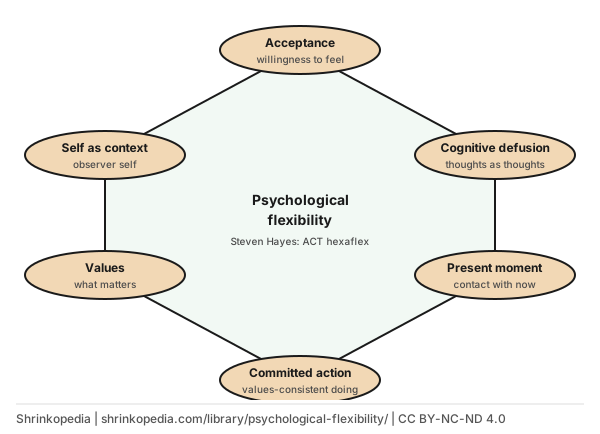
The six habits that build it
Being present
Noticing what is happening right now, in the body and in the world, rather than being pulled entirely into past or future.
Cognitive defusion
Seeing thoughts as thoughts rather than as instructions or facts. "I am thinking that I will fail" gives you room. "I will fail" does not.
Acceptance
Making space for painful feelings instead of trying to suppress them. Suppression takes energy and does not work. Making space is not liking. It is not fighting.
Self as context
Recognizing that you are the observer of your thoughts, feelings, and roles, not identical to any of them. This gives room to move even when specific parts of you are stuck.
Values
Clarifying what you want your life to be about, in specific enough terms to guide daily action. Not goals. Directions.
Committed action
Taking steps toward the values you named, even when the internal weather is difficult. This is where the flexibility actually shows up.
How to use this page
- When you feel stuck, ask which of the six is thin right now. Different weakness needs different practice.
- Do the smallest available values-consistent action. Wait for motivation is a losing strategy. Action is what builds motivation.
- Practice noticing thoughts as thoughts several times a day, when it is easy. The skill is available in a crisis only if you have used it in ordinary weather.
Worth knowing
Psychological flexibility is not a personality trait. It is a set of practicable skills. That means you build it, and losing it in a hard period is not evidence of failure. It is evidence of a hard period.
Developed by Steven Hayes and colleagues as the core of acceptance and commitment therapy. Strong evidence across depression, anxiety, chronic pain, and behavior change.
See also on ShrinkDaily
- ShrinkDaily's daily concept on psychological flexibility
For a three-minute daily read on the same idea, see ShrinkDaily's daily concept on psychological flexibility.
How to cite this page
- Short
Psychological flexibility. Shrinkopedia, medically reviewed by Shariq Refai, MD, MBA. https://shrinkopedia.com/library/psychological-flexibility/- APA
Shrinkopedia. (n.d.). Psychological flexibility. Medically reviewed by Shariq Refai, MD, MBA. https://shrinkopedia.com/library/psychological-flexibility/- MLA
"Psychological flexibility." Shrinkopedia, https://shrinkopedia.com/library/psychological-flexibility/.
Click a citation to select it.