Self-efficacy
The belief that you can do the thing, which turns out to change whether you can.
1 min read
Reviewed by Shariq Refai, MD, MBA, FAPA. Verify: ORCID, Wikidata, NPI Registry, all links.
Self-efficacy is the belief that you can carry out a specific task or set of tasks. It is not the same as self-esteem or self-confidence in general. It is task specific: this thing, this domain, this challenge. Decades of research shows it strongly predicts effort, persistence, and outcomes. It is also a belief you can build.
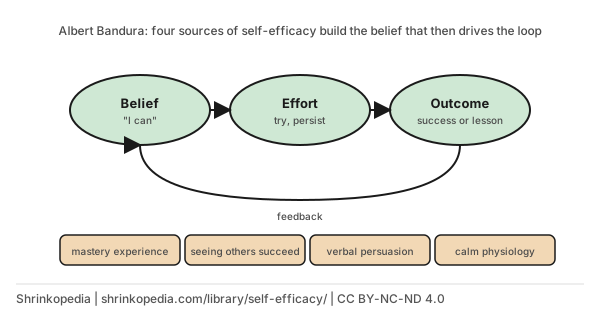
Where self-efficacy comes from
Mastery experience
Direct success at the task builds it strongest. Small early wins matter more than one big later one.
Vicarious experience
Seeing someone like you do the task. Similarity matters. This is why representation and role models are not sentimental. They are structural.
Social persuasion
Being told by someone credible that you can. This works best from people whose judgment you already trust, and in doses that are grounded rather than hyped.
Physiological state
The body's signals get read as evidence. High arousal can be read as excitement or as fear, and the reading affects performance. Reframing the sensation shifts the belief.
Verbal persuasion has limits
Words alone rarely overcome no experience. Belief follows evidence, and mastery is the strongest evidence.
How to use this page
- Build self-efficacy through structured small wins. Design the first steps to be doable rather than impressive.
- When learning a hard skill, seek out people who look like you doing it. Similarity signals possibility.
- Reframe the body cues. Nervous can be read as ready. Same physiology, different meaning.
Worth knowing
Self-efficacy is a domain specific belief. High self-efficacy for cooking does not carry over to public speaking. This is good news: you can start from where you are and build in the specific area that matters, without waiting to become confident in general.
Developed by Albert Bandura from the 1970s onward. Central to social cognitive theory and to modern behavior change frameworks.
See also on ShrinkDaily
- ShrinkDaily's daily concept on self-efficacy
For a three-minute daily read on the same idea, see ShrinkDaily's daily concept on self-efficacy.
How to cite this page
- Short
Self-efficacy. Shrinkopedia, medically reviewed by Shariq Refai, MD, MBA. https://shrinkopedia.com/library/self-efficacy/- APA
Shrinkopedia. (n.d.). Self-efficacy. Medically reviewed by Shariq Refai, MD, MBA. https://shrinkopedia.com/library/self-efficacy/- MLA
"Self-efficacy." Shrinkopedia, https://shrinkopedia.com/library/self-efficacy/.
Click a citation to select it.