Locus of control
Where you place the source of what happens to you, and why it shapes what you do next.
1 min read
Reviewed by Shariq Refai, MD, MBA, FAPA. Verify: ORCID, Wikidata, NPI Registry, all links.
Locus of control is a belief about where the causes of what happens to you live. Internal locus: my actions matter. External locus: outside forces decide. Almost everyone has some of both, and the pattern shifts by domain. The mix predicts a lot about how people handle setbacks, plan effort, and treat their own behavior.
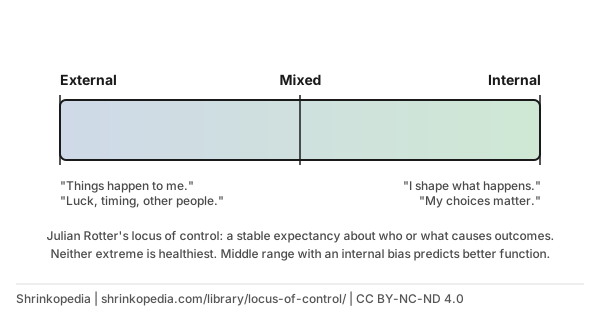
What internal and external look like
Internal locus
You attribute outcomes largely to your own actions. Effort, choices, preparation, and skill are the main story. Setbacks trigger review and adjustment.
External locus
You attribute outcomes largely to forces outside your control. Luck, chance, other people, systems, fate. Setbacks feel like weather.
Neither is right in all cases
Reality includes both. Effort matters. Systems matter. Chance matters. Assigning weight accurately in a given situation is more useful than picking one style for life.
Where each helps and hurts
Internal locus supports action, planning, and persistence, and can turn corrosive when applied to things you truly cannot control. External locus reduces self-blame for things outside your hand, and can freeze action for things inside it.
It is not fixed
Experiences that show your actions matter build internal locus. Chronic environments that punish agency build external locus. The mix moves.
How to use this page
- For a stuck situation, ask what part of this is actually inside my control? Focus effort there.
- For a painful situation, ask what part of this was actually outside my control? Take the weight off there.
- Notice which style is your default, and check whether it fits the situation in front of you.
Worth knowing
The healthiest pattern in most research is not maximum internal locus. It is accurate internal locus: strong belief that effort and choices matter, combined with clear recognition of the parts of life that were never yours to control.
Introduced by Julian Rotter in the 1950s and 60s. Widely researched in relation to mental health, achievement, and health behavior.
See also on ShrinkDaily
- ShrinkDaily's daily concept on locus of control
For a three-minute daily read on the same idea, see ShrinkDaily's daily concept on locus of control.
How to cite this page
- Short
Locus of control. Shrinkopedia, medically reviewed by Shariq Refai, MD, MBA. https://shrinkopedia.com/library/locus-of-control/- APA
Shrinkopedia. (n.d.). Locus of control. Medically reviewed by Shariq Refai, MD, MBA. https://shrinkopedia.com/library/locus-of-control/- MLA
"Locus of control." Shrinkopedia, https://shrinkopedia.com/library/locus-of-control/.
Click a citation to select it.