Learned helplessness
When repeated uncontrollable events teach a nervous system to stop trying, even after control is possible.
2 min read
Reviewed by Shariq Refai, MD, MBA, FAPA. Verify: ORCID, Wikidata, NPI Registry, all links.
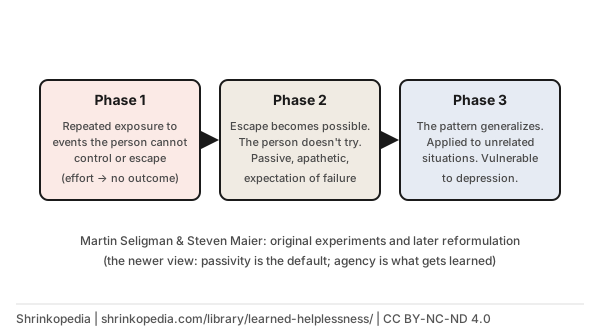
Learned helplessness describes what happens when a person or animal, faced with repeated uncontrollable stress, stops trying, even in later situations where they could act effectively. It was the foundational lab model of depression for decades and remains a useful lens for understanding stuck behavior. The updated understanding matters: helplessness is the default response, and agency is the learned override.
How it works
Uncontrollable stress
Not just stress. Stress that the person cannot escape or influence. Trauma, chronic pain, oppressive systems, unpredictable environments, cruel relationships.
The response generalizes
After enough uncontrollable events, the nervous system starts to treat new events as also uncontrollable. It stops testing whether action would help.
What it looks like
Passivity in the face of solvable problems. Difficulty starting. A sense of futility that feels like fact. Depression often includes this. So does prolonged burnout.
The updated science
Newer research from Steven Maier and Martin Seligman revised the model. Helplessness is the default response to prolonged aversive stress. Learning that you have control is what shuts it down. Agency is the acquired skill, not the passivity.
What reverses it
Repeated experiences of small effective action. Environments where actions actually change outcomes. Sometimes medication that supports the underlying depression. Almost always some form of relationship that models agency back.
How to use this page
- For someone who looks stuck, giving advice about trying harder rarely helps. Structured small wins that show action leads somewhere often do.
- For yourself, name where the pattern was learned. Naming the origin is not the cure, but it changes the story from you are broken to you learned this in the environment that taught it.
- Look for one place today where a small action actually changes the outcome. Repeat.
Worth knowing
The old story was that depression teaches you helplessness. The current story is that helplessness is the default under prolonged uncontrollable stress, and depression prevents relearning agency. That change matters because it points at the intervention: not more effort, but structured evidence that action still changes outcomes.
Originally described by Martin Seligman and Steven Maier in the 1960s. Their revised model, published in 2016, reframes the phenomenon around agency rather than passivity.
See also on ShrinkDaily
- ShrinkDaily's daily concept on learned helplessness
For a three-minute daily read on the same idea, see ShrinkDaily's daily concept on learned helplessness.
How to cite this page
- Short
Learned helplessness. Shrinkopedia, medically reviewed by Shariq Refai, MD, MBA. https://shrinkopedia.com/library/learned-helplessness/- APA
Shrinkopedia. (n.d.). Learned helplessness. Medically reviewed by Shariq Refai, MD, MBA. https://shrinkopedia.com/library/learned-helplessness/- MLA
"Learned helplessness." Shrinkopedia, https://shrinkopedia.com/library/learned-helplessness/.
Click a citation to select it.