Theory of mind
The everyday ability to model what other people are thinking and feeling.
2 min read
Reviewed by Shariq Refai, MD, MBA, FAPA. Verify: ORCID, Wikidata, NPI Registry, all links.
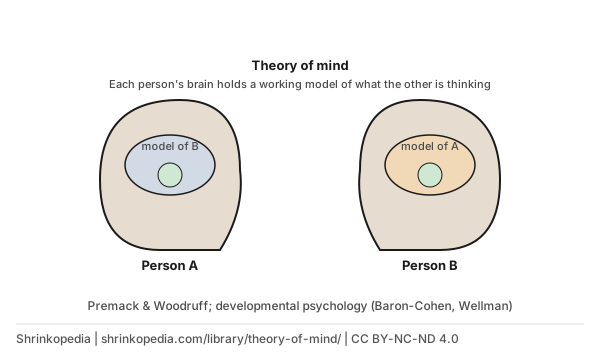
Theory of mind is the ability to model what other people know, believe, feel, and intend. It is the foundation of ordinary social life. It develops in childhood, wobbles under stress, differs across people, and gets easier when we slow down. It is not empathy. Empathy is what happens when the model connects to feeling. Theory of mind is the model itself.
What it does
Predicts behavior
You anticipate what someone will do next by modeling what they seem to know and want. Without this, other people would look like weather.
Enables communication
You adjust what you say based on what you think the other person already understands. Every conversation runs on a running model of the other mind.
Explains missed reads
When you are certain someone knows something they do not, or feels something they do not, the model is off. This is the source of many familiar arguments.
Wobbles under load
Stress, fatigue, hunger, alcohol, strong emotion, and heavy demands all thin your theory of mind. This is why hard conversations go badly at the end of hard days.
Varies between people
The skill is not distributed evenly. Autism, some brain injuries, and some psychiatric conditions affect it. So do simple habits of attention. It can grow with practice.
How to use this page
- In an argument, pause and ask what the other person likely believes right now, and why that belief makes sense from where they are sitting.
- When you catch yourself sure of what someone else thinks or feels, ask when you last actually checked. Certainty is often the model, not the person.
- For hard conversations, meet when both nervous systems are steadier. Theory of mind is expensive and needs resources.
Worth knowing
Theory of mind is not the same as being nice, being smart, or being right. It is the capacity to hold another mind in mind, even when you disagree with what is in it. That capacity is what makes real communication possible.
The phrase comes from primatologists David Premack and Guy Woodruff in 1978. Widely developed in developmental psychology, cognitive neuroscience, and clinical work.
See also on ShrinkDaily
- ShrinkDaily's daily concept on theory of mind
For a three-minute daily read on the same idea, see ShrinkDaily's daily concept on theory of mind.
How to cite this page
- Short
Theory of mind. Shrinkopedia, medically reviewed by Shariq Refai, MD, MBA. https://shrinkopedia.com/library/theory-of-mind/- APA
Shrinkopedia. (n.d.). Theory of mind. Medically reviewed by Shariq Refai, MD, MBA. https://shrinkopedia.com/library/theory-of-mind/- MLA
"Theory of mind." Shrinkopedia, https://shrinkopedia.com/library/theory-of-mind/.
Click a citation to select it.