The Yerkes-Dodson curve
Too little pressure and you cannot get moving. Too much and you fall apart. There is a middle.
1 min read
Reviewed by Shariq Refai, MD, MBA, FAPA. Verify: ORCID, Wikidata, NPI Registry, all links.
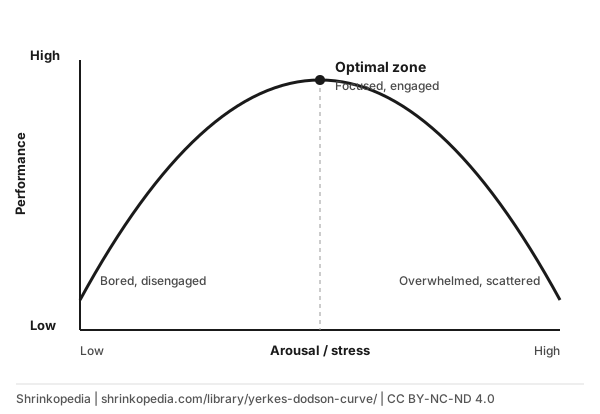
The Yerkes-Dodson curve is a classic inverted-U relationship between arousal and performance. Too little arousal and you underperform because you are underengaged. Too much and you underperform because you are overwhelmed. Somewhere in the middle is a range where you do your best work. The point is not to be relaxed or fired up. It is to notice where the middle sits for the task at hand.
How the curve works
Low arousal, low performance
Bored, sleepy, disengaged. The task cannot get traction because the system is not on.
Moderate arousal, best performance
Alert, focused, engaged. Enough pressure to matter. Not so much that thinking narrows.
High arousal, low performance
Anxious, scattered, tunnel visioned. Cognitive resources go to the alarm rather than to the task.
The optimum shifts by task
Simple tasks tolerate higher arousal. Complex, novel, or effortful tasks need lower arousal. This is why a stressful morning can wreck a hard writing session while barely denting a routine one.
You can steer
If arousal is low, add a small deadline, a small stake, or physical movement. If arousal is high, slow the breath, get some physical release, break the task into smaller pieces.
How to use this page
- Before hard work, quickly rate your arousal. Then move it toward the middle of the range that fits the task.
- Complex tasks need calmer bodies than most people give them.
- Rest and sleep matter here because they set your available range for the day. You cannot productively steer if the tank is empty.
Worth knowing
The curve is a heuristic, not a law. Real performance depends on many things, including skill, motivation, sleep, and the specific task. But the inverted-U shape holds well enough as a compass to be useful in real time.
Named after psychologists Robert Yerkes and John Dodson, who published the original animal studies in 1908. Widely reinterpreted in modern human performance and stress research.
See also on ShrinkDaily
- ShrinkDaily's daily concept on yerkes-dodson law
For a three-minute daily read on the same idea, see ShrinkDaily's daily concept on yerkes-dodson law.
How to cite this page
- Short
The Yerkes-Dodson curve. Shrinkopedia, medically reviewed by Shariq Refai, MD, MBA. https://shrinkopedia.com/library/yerkes-dodson-curve/- APA
Shrinkopedia. (n.d.). The Yerkes-Dodson curve. Medically reviewed by Shariq Refai, MD, MBA. https://shrinkopedia.com/library/yerkes-dodson-curve/- MLA
"The Yerkes-Dodson curve." Shrinkopedia, https://shrinkopedia.com/library/yerkes-dodson-curve/.
Click a citation to select it.