Alexithymia
A muted ability to notice and name feelings, and why it is treatable rather than fixed.
2 min read
Reviewed by Shariq Refai, MD, MBA, FAPA. Verify: ORCID, Wikidata, NPI Registry, all links.
Alexithymia describes a specific pattern: difficulty identifying feelings, difficulty describing them to others, and a mind that tends to run externally rather than reflectively. The word literally means "no word for feelings." It is not an emotion disorder. It is a set of skills that developed lightly, often for good reasons, and that can be built.
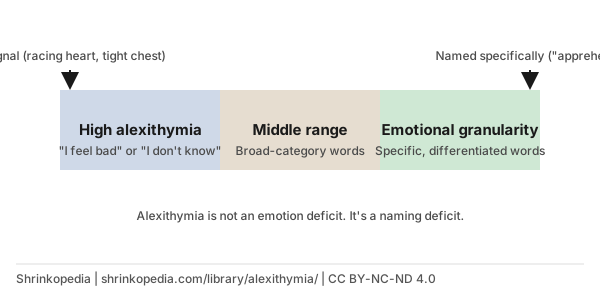
What alexithymia looks like
Feelings register as body
You feel a tight chest, a stomach knot, a heaviness, without a matching emotional word. Somewhere in there is a feeling. It is just harder to see.
Feelings surprise you
You cry, get angry, or shut down without seeing it coming. The signal was there. It was not translated in time.
External focus
You talk about facts, tasks, and other people more comfortably than about your own internal state. It is not evasion. It is where attention naturally goes.
Common overlaps
Higher rates in autism, in trauma histories, in chronic pain, in eating disorders, and in some depression and substance use pictures. Common enough to matter, not universal in any of them.
It is trainable
Emotion focused therapies, body based work, and simple daily naming practice all build the skills that alexithymia describes.
How to use this page
- Once a day, pause and check the body. Ask what feeling would fit the sensation you notice. If nothing lands, that is fine. Consistent asking widens the vocabulary over time.
- Journaling that describes situations and body states, then guesses at a feeling, is one of the most reliable ways to build the skill.
- If someone in your life has strong alexithymia, meet them where the language is: facts and body first, feeling word later.
Worth knowing
Alexithymia is not a diagnosis in the DSM. It is a construct, measured on a spectrum, that shows up more in certain populations. Treating it as a trainable set of skills fits the evidence and matches how change actually happens.
Coined by Peter Sifneos in 1972 and studied extensively since. Measured most often with the Toronto Alexithymia Scale.
See also on ShrinkDaily
- ShrinkDaily's daily concept on alexithymia
For a three-minute daily read on the same idea, see ShrinkDaily's daily concept on alexithymia.
How to cite this page
- Short
Alexithymia. Shrinkopedia, medically reviewed by Shariq Refai, MD, MBA. https://shrinkopedia.com/library/alexithymia/- APA
Shrinkopedia. (n.d.). Alexithymia. Medically reviewed by Shariq Refai, MD, MBA. https://shrinkopedia.com/library/alexithymia/- MLA
"Alexithymia." Shrinkopedia, https://shrinkopedia.com/library/alexithymia/.
Click a citation to select it.