Emotion granularity
The more precisely you can name a feeling, the more you can do with it.
1 min read
Reviewed by Shariq Refai, MD, MBA, FAPA. Verify: ORCID, Wikidata, NPI Registry, all links.
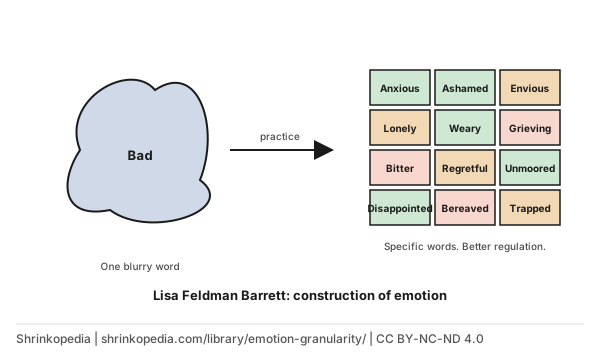
Emotion granularity is the ability to distinguish between similar feelings with precision. Someone with high granularity does not just feel bad. They feel disappointed, or rejected, or embarrassed, or bored. It sounds like a vocabulary lesson. It is closer to a regulation skill.
Why granularity matters
Names change the signal
The brain uses your labels to build the feeling. A more specific label produces a more specific signal, which is easier to respond to than a vague pull.
Names guide action
Sad points to comfort. Angry points to boundary. Anxious points to a threat check. Bad does not point anywhere.
Names shrink intensity
Studies show that accurately naming an emotion reduces the reactivity linked to it. It is not a magic trick. It is the shift from being the feeling to observing it.
It predicts wellbeing
Higher emotion granularity is associated with less depression, less anxiety, better relationships, and better response to therapy in multiple studies.
It is a skill, not a trait
You can build it. Reading and writing about emotions expands the vocabulary. Paying deliberate attention to inside your body sharpens the discrimination.
How to use this page
- When you notice a feeling, try to name it more precisely than your first attempt. If you land on "upset," try again. Is it hurt, angry, disappointed, ashamed?
- Keep a feelings word list somewhere accessible. When words are missing, granularity is capped by what you can access.
- Notice the body signature that goes with a name. Pairing name to sensation is what makes the label real.
Worth knowing
Granularity is not about performing emotional sophistication. It is about giving your regulation system a more specific tool. Precise naming does not require perfect words. It requires the honest attempt.
Developed and studied extensively by Lisa Feldman Barrett and colleagues, building on constructionist theories of emotion.
See also on ShrinkDaily
- ShrinkDaily's daily concept on emotional granularity
For a three-minute daily read on the same idea, see ShrinkDaily's daily concept on emotional granularity.
How to cite this page
- Short
Emotion granularity. Shrinkopedia, medically reviewed by Shariq Refai, MD, MBA. https://shrinkopedia.com/library/emotion-granularity/- APA
Shrinkopedia. (n.d.). Emotion granularity. Medically reviewed by Shariq Refai, MD, MBA. https://shrinkopedia.com/library/emotion-granularity/- MLA
"Emotion granularity." Shrinkopedia, https://shrinkopedia.com/library/emotion-granularity/.
Click a citation to select it.