Interoception
The sense of what is happening inside your body, and why it shapes emotion.
2 min read
Reviewed by Shariq Refai, MD, MBA, FAPA. Verify: ORCID, Wikidata, NPI Registry, all links.
Interoception is the perception of internal body states: heart rate, breathing, temperature, muscle tension, gut, bladder, hunger. It is the sensory system for the inside. It is also one of the main ingredients of what you experience as an emotion. Getting to know it changes how you notice, name, and respond to what your body is doing.
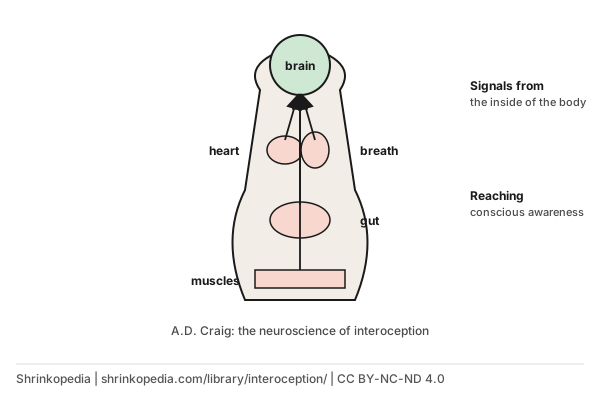
What interoception does
Feeds emotion
You do not just feel sad or afraid in the mind. You feel it as a specific body pattern. Interoception is how you register that pattern.
Signals need
Hunger, thirst, fatigue, and physical illness all show up here first. When interoception is muted, needs get missed until they escalate.
Shapes anxiety
In panic disorder, ordinary body sensations get read as danger. The interoceptive signal is fine. The interpretation is not. That is what exposure therapy for panic targets.
Varies between people
Some people are highly aware of their internal state, sometimes uncomfortably so. Others are underconnected to it. Neither is a fault. Both can be worked with.
Trainable
Body-based practices, mindfulness, some forms of therapy, and simple daily attention to sensations all sharpen it. Sharper does not mean louder. It means more accurate.
How to use this page
- Pause twice a day and scan: what does your body actually feel like right now, without changing anything?
- When an emotion arrives, ask where in the body you notice it, and what specific sensation is there. This changes how the feeling moves.
- If interoceptive signals distress you (panic, health anxiety), a therapist trained in interoceptive exposure can help you meet the signal without escalating it.
Worth knowing
Interoception matters because emotion is not something that happens to you and then registers in the body. It is closer to the reverse. The body produces the pattern, and the brain gives it a name. Which means that changing what the body is doing changes what the emotion is.
The term was formalized by physiologist A.D. Craig in the 2000s. Interoception is now foundational in modern emotion science, particularly in the constructionist model developed by Lisa Feldman Barrett.
See also on ShrinkDaily
- ShrinkDaily's daily concept on interoception
For a three-minute daily read on the same idea, see ShrinkDaily's daily concept on interoception.
How to cite this page
- Short
Interoception. Shrinkopedia, medically reviewed by Shariq Refai, MD, MBA. https://shrinkopedia.com/library/interoception/- APA
Shrinkopedia. (n.d.). Interoception. Medically reviewed by Shariq Refai, MD, MBA. https://shrinkopedia.com/library/interoception/- MLA
"Interoception." Shrinkopedia, https://shrinkopedia.com/library/interoception/.
Click a citation to select it.