Fight, flight, freeze, fawn
The four automatic threat responses, and why they are not choices you make.
2 min read
Reviewed by Shariq Refai, MD, MBA, FAPA. Verify: ORCID, Wikidata, NPI Registry, all links.
When the nervous system registers threat, it selects a response fast, without asking you first. The classic pair is fight or flight. Two more are now widely recognized in clinical work: freeze and fawn. Knowing your patterns is not about labeling yourself. It is about understanding why the same situation triggers the same reaction every time.
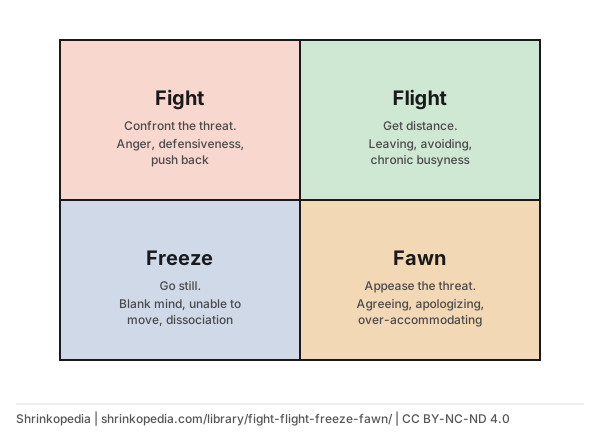
The four responses
Fight
Confront the threat. Signs: anger, tension, raised voice, defensiveness, a strong pull to argue or push back. Useful when the threat is fair, corrosive when it is not.
Flight
Get distance from the threat. Signs: leaving, avoiding, distracting, restlessness, chronic busyness. Protective in real danger, exhausting when danger is not there.
Freeze
Go still. Signs: blank mind, unable to speak, unable to move, dissociation. Common when neither fight nor flight is possible. Not weakness. A well-evolved response to being trapped.
Fawn
Appease the threat. Signs: agreeing, apologizing, over-accommodating, prioritizing the other person to reduce danger. Often learned in childhood environments where safety depended on managing someone else.
You have a default
Most people lean toward one under pressure. That default was shaped by early experience and by what worked at the time. It is not a personality verdict.
How to use this page
- After a difficult moment, name which response showed up. Naming is the first step in interrupting the pattern.
- Your default is not wrong. It is protective. The goal is more options, not a different you.
- When you can, add safety cues to the situation: someone with you, a way out, familiar surroundings. New responses become possible when the nervous system is less pressed.
Worth knowing
These responses are not conscious choices. They are output of a nervous system built to keep you alive. Which means that changing them is not a matter of trying harder. It is a matter of giving the nervous system enough repeated safety cues over time that a new response becomes available.
Fight and flight described by Walter Cannon in 1915. Freeze added through work by Peter Levine and stress physiology researchers. Fawn popularized by Pete Walker in the trauma literature.
See also on ShrinkDaily
- ShrinkDaily's daily concept on fight flight freeze fawn
For a three-minute daily read on the same idea, see ShrinkDaily's daily concept on fight flight freeze fawn.
How to cite this page
- Short
Fight, flight, freeze, fawn. Shrinkopedia, medically reviewed by Shariq Refai, MD, MBA. https://shrinkopedia.com/library/fight-flight-freeze-fawn/- APA
Shrinkopedia. (n.d.). Fight, flight, freeze, fawn. Medically reviewed by Shariq Refai, MD, MBA. https://shrinkopedia.com/library/fight-flight-freeze-fawn/- MLA
"Fight, flight, freeze, fawn." Shrinkopedia, https://shrinkopedia.com/library/fight-flight-freeze-fawn/.
Click a citation to select it.