Confirmation bias
The default habit of noticing evidence that fits your existing view and skimming past what does not.
1 min read
Reviewed by Shariq Refai, MD, MBA, FAPA. Verify: ORCID, Wikidata, NPI Registry, all links.
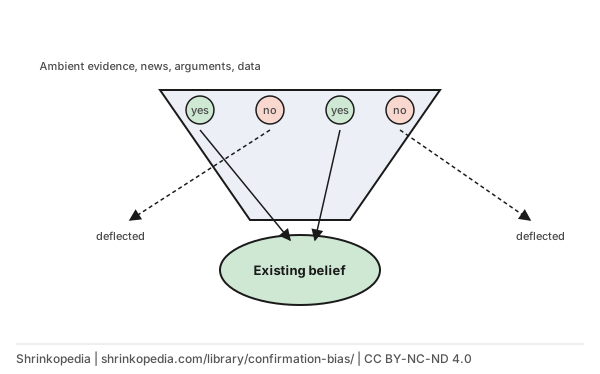
Confirmation bias is the tendency to seek, notice, and remember information that supports what you already believe, and to overlook, dismiss, or forget information that does not. Everyone does it. It is the reason two thoughtful people can read the same article and come away more certain of opposite conclusions.
How it works
Selective attention
The brain scans for what fits. Same feed, same room, same conversation, and two people leave with different highlights.
Selective memory
Confirming events get stored with detail. Disconfirming events fade. Over time this makes past experience feel like proof, when it is really a filter.
Biased search
You Google in ways that favor your view. "Why is X bad" and "why is X good" return two different internets.
Motivated reasoning
When new information threatens something you care about, effort goes into finding reasons to reject it rather than weighing it.
In relationships and mental health
In depression it locks onto evidence you are unworthy. In anxiety it locks onto evidence you are unsafe. In conflict it locks onto evidence the other person is the problem.
How to use this page
- Before deciding something important, name what you expect to find, then look for disconfirming evidence with the same effort.
- In an argument, try to state the other side well enough that a person on that side would say you got it right. Then respond.
- Notice when you are searching to be right rather than to be accurate. They feel similar. They are not the same.
Worth knowing
Confirmation bias is not a sign of low intelligence. In fact, more skilled reasoners are often better at generating supporting arguments for whatever they already believe. Intelligence sharpens the tool. Metacognition points the tool at the right target.
Studied experimentally since Peter Wason in the 1960s. Widely replicated across decision-making, medicine, politics, and clinical psychology.
See also on ShrinkDaily
- ShrinkDaily's daily concept on confirmation bias
For a three-minute daily read on the same idea, see ShrinkDaily's daily concept on confirmation bias.
How to cite this page
- Short
Confirmation bias. Shrinkopedia, medically reviewed by Shariq Refai, MD, MBA. https://shrinkopedia.com/library/confirmation-bias/- APA
Shrinkopedia. (n.d.). Confirmation bias. Medically reviewed by Shariq Refai, MD, MBA. https://shrinkopedia.com/library/confirmation-bias/- MLA
"Confirmation bias." Shrinkopedia, https://shrinkopedia.com/library/confirmation-bias/.
Click a citation to select it.