The habit loop
Cue, routine, reward. The three-part shape almost every habit lives in.
2 min read
Reviewed by Shariq Refai, MD, MBA, FAPA. Verify: ORCID, Wikidata, NPI Registry, all links.
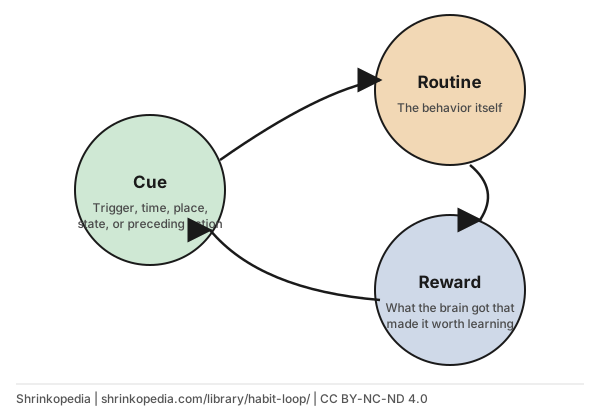
The habit loop is a simple model for how automatic behaviors form and stick. It has three parts: a cue that triggers the behavior, a routine that runs, and a reward that reinforces the pattern. Almost every stubborn habit lives in this shape. Naming the pieces makes it possible to change the ones you can actually change.
The three parts
Cue
The trigger. A time, a place, a state (bored, tired, stressed), a preceding action, or another person. Cues are where habits actually live.
Routine
The behavior itself. Check the phone, pour the drink, open the app, snap at the family. The visible part.
Reward
Whatever the brain got that made the routine worth learning. Often not the obvious thing. The real reward is often relief, distraction, novelty, or connection.
The craving that binds them
Once a loop is established, the cue itself produces a felt urge for the reward, before the routine even happens. That craving is the glue.
Environment does the heavy lifting
Cues and easy access to the routine are usually more powerful than willpower. Changing the environment often does what changing the person cannot.
How to use this page
- For a habit you want to change, identify the cue and the actual reward. Not the surface reward. The one the brain is chasing.
- You can rarely delete a habit. You can substitute a new routine that answers the same cue with a similar reward.
- For a habit you want to build, choose a stable cue you cannot miss, make the routine embarrassingly small at first, and pay attention to the reward immediately after. The brain needs to notice.
Worth knowing
Habits are not weakness. They are how a limited brain runs a complicated life. The goal is not to have no habits. It is to have habits that match the life you want, which starts with recognizing which loops are actually running.
Popularized by Charles Duhigg's synthesis of habit research. Grounded in decades of behavioral and neuroscience work on cue-response learning and by Wendy Wood on habit formation.
See also on ShrinkDaily
- ShrinkDaily's daily concept on habit loop
For a three-minute daily read on the same idea, see ShrinkDaily's daily concept on habit loop.
How to cite this page
- Short
The habit loop. Shrinkopedia, medically reviewed by Shariq Refai, MD, MBA. https://shrinkopedia.com/library/habit-loop/- APA
Shrinkopedia. (n.d.). The habit loop. Medically reviewed by Shariq Refai, MD, MBA. https://shrinkopedia.com/library/habit-loop/- MLA
"The habit loop." Shrinkopedia, https://shrinkopedia.com/library/habit-loop/.
Click a citation to select it.