The polyvagal ladder
A simple model of three nervous system states, and how you move between them.
2 min read
Reviewed by Shariq Refai, MD, MBA, FAPA. Verify: ORCID, Wikidata, NPI Registry, all links.
The polyvagal ladder is a simplified way to describe three states the autonomic nervous system moves between. It comes from the polyvagal theory developed by Stephen Porges and popularized clinically by Deb Dana. It is a model, not a mechanism, and it is genuinely useful for recognizing what state you are in and what helps you move.
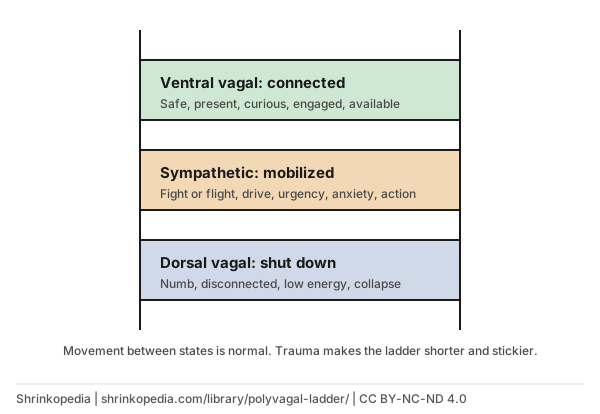
The three states
Ventral vagal: connected
The top of the ladder. Safe, present, socially engaged. Face, voice, and eyes soft. Breathing easy. Curious about the world. Available for connection.
Sympathetic: mobilized
The middle. Threat activation. Heart rate up, muscles ready, alert. Depending on context this is drive and energy, or anxiety and fight or flight.
Dorsal vagal: shut down
The bottom. When mobilization fails or is impossible, the system pulls back. Numb, low energy, disconnected, sometimes collapsed. Not laziness. A protective response.
You move between them
The states are not fixed. You climb up and slide down through the day. Trauma and chronic stress make the ladder shorter and stickier. Regulation practices lengthen it back out.
Co-regulation matters
The fastest way back up the ladder is often another regulated nervous system. Voice, eye contact, calm presence. Human beings are wired to borrow state from each other.
How to use this page
- Notice which rung you are on before you decide what to do. Different rungs need different moves.
- From sympathetic, try discharge and orientation: movement, slow exhale, name what is around you. Trying to relax straight down does not work when the system is up.
- From dorsal, try tiny, safe activation: sit up, look around, one small task. Big pushes backfire from shutdown.
Worth knowing
The ladder is a heuristic, not a literal map of the vagus nerve. It is useful because it gives you three clear categories to work with in real time, and it points at the interventions that match each state. Treat it as a compass, not a diagram.
Based on the polyvagal theory of Stephen Porges. The ladder framing is drawn from Deb Dana's clinical work. Polyvagal theory is influential in clinical practice and continues to be debated in basic autonomic neuroscience.
See also on ShrinkDaily
- ShrinkDaily's daily concept on polyvagal ladder
For a three-minute daily read on the same idea, see ShrinkDaily's daily concept on polyvagal ladder.
How to cite this page
- Short
The polyvagal ladder. Shrinkopedia, medically reviewed by Shariq Refai, MD, MBA. https://shrinkopedia.com/library/polyvagal-ladder/- APA
Shrinkopedia. (n.d.). The polyvagal ladder. Medically reviewed by Shariq Refai, MD, MBA. https://shrinkopedia.com/library/polyvagal-ladder/- MLA
"The polyvagal ladder." Shrinkopedia, https://shrinkopedia.com/library/polyvagal-ladder/.
Click a citation to select it.